
Shockwave Therapy
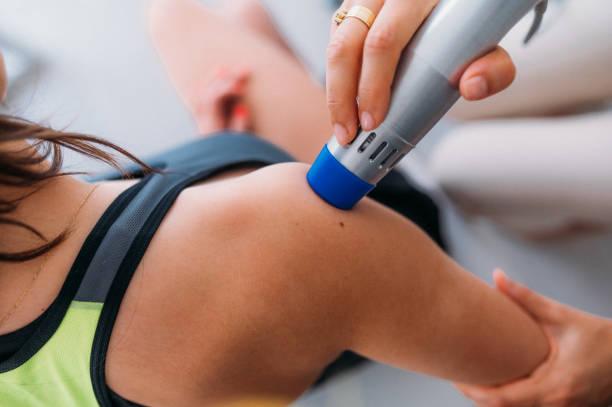
What is Shockwave Therapy? Extracorporeal shockwave therapy (ESWT) is a non- surgical treatment that delivers mechanical energy through focused sound waves to stimulate healing processes in target tissues. In musculoskeletal care, ESWT can augment routine care for many conditions.
How does it work? ESWT produces rapid changes in local pressure and mechanical stresses, causing temporary stretching and compression at the cellular level—a phenomenon called mechanotransduction. This physical stimulus activates specific cellular pathways, promoting tissue regeneration by triggering the release of growth factors, angiogenesis (formation of new blood vessels), and recruitment of regenerative cells. Additionally, ESWT causes microscopic bubbles (cavitation) to form and collapse, amplifying local mechanical effects. Importantly, ESWT’s regenerative effects occur at controlled energy levels without causing cell injury or significant thermal effects. What to expect. Treatment is done in the clinic. Gel is often applied to the skin and a handheld applicator delivers pulses to the treatment area. Sessions typically last less than 15 minutes. The frequency of treatment depends on the diagnosis and individual response. Discomfort during treatment is common though analgesia is generally not necessary. Treatment parameters are initially set to lower power settings and increased with feedback from the patient / athlete (pain-adapted dosing). The power settings, duration, and frequency of ESWT is based on indication, clinician insight, and patient feedback.
After your session. Mild soreness, redness, or mild bruising can occur for a day or two. Ask your physical therapist or clinician about managing any post-procedural soreness.
Safety and Contraindications. ESWT has a favorable safety profile. However, caution must be used with certain medical considerations. Notify your team if you have an active malignancy, have a bleeding disorder, have an implanted cardiac device, or are pregnant.
Selected References
Achilles tendinopathy
1. Furia JP. High-energy extracorporeal shock wave therapy as a treatment for insertional Achilles tendinopathy. Am J Sports Med. 2006;34(5):733-740 .
2. Rompe JD, Nafe B, Furia JP, Maffulli N. Eccentric loading, shock-wave treatment, or a wait-and-see policy for tendinopathy of the main body of tendo Achillis: a randomized controlled trial. Am J Sports Med. 2007;35(3):374-383.
3. Rompe JD, Furia JP, Maffulli N. Eccentric loading compared with shockwave treatment for chronic insertional Achilles tendinopathy: a randomized, controlled trial. J Bone Joint Surg Am. 2008;90(1):52-61.
Calcific rotator cuff tendinopathy
4. Gerdesmeyer L, Wagenpfeil S, Haake M, et al. Extracorporeal shock wave therapy for chronic calcifying tendinitis of the rotator cuff: a randomized controlled trial. JAMA. 2003;290(19):2573-2580.
Greater trochanteric pain syndrome
5. Furia JP, Rompe JD, Maffulli N. Low-energy extracorporeal shock wave therapy as a treatment for greater trochanteric pain syndrome. Am J Sports Med. 2009;37(9):1806-1813.
6. Rompe JD, Segal NA, Cacchio A, Furia JP, Morral A, Maffulli N. Home training, local corticosteroid injection, or radial shock wave therapy for greater trochanter pain syndrome. Am J Sports Med.
2009;37(10):1981-1990.
Hamstring tendinopathy
7. Cacchio A, Rompe JD, Furia JP, Susi P, Santilli V, De Paulis F. Shock wave therapy for the treatment of chronic proximal hamstring tendinopathy in professional athletes. Am J Sports Med. 2011;39(1):146-153.
8. Furia JP, Rompe JD, Cacchio A, Maffulli N. Shock wave therapy as a treatment of nonunions, avascular necrosis, and delayed healing of stress fractures. Foot Ankle Clin. 2010;15(4):651-662.
Lateral epicondylopathy
9. Rompe JD, Decking J, Schoellner C, Theis C. Repetitive low-energy shock wave treatment for chronic lateral epicondylitis in tennis players. Am J Sports Med. 2004;32(3):734-743.
Medial tibial stress syndrome
10. Gomez Garcia S, Ramón Róna S, Gomez Tinoco MC, et al. Shockwave treatment for medial tibial stress syndrome in military cadets: a single-blind randomized controlled trial. Int J Surg. 2017;46:102-109.
11. Moen MH, Rayer S, Schipper M, et al. Shockwave treatment for medial tibial stress syndrome in athletes: a prospective controlled study. Br J Sports Med. 2012;46(4):253-257.
Myofascial pain syndrome
12. Jeon JH, Jung YJ, Lee JY, et al. The effect of extracorporeal shock wave therapy on myofascial pain syndrome. Ann Rehabil Med. 2012;36(5):665-674.
13. Ji HM, Kim HJ, Han SJ. Extracorporeal shock wave therapy in myofascial pain syndrome of upper
trapezius. Ann Rehabil Med. 2012;36(5):675-680.
Patellar tendinopathy
14. Wang CJ, Ko JY, Chan YS, Weng LH, Hsu SL. Extracorporeal shockwave therapy for chronic patellar
tendinopathy. Am J Sports Med. 2007;35(6):972-978.
15. van Leeuwen MT, Zwerver J, van den Akker-Scheek I. Extracorporeal shockwave therapy for patellar
tendinopathy: a review of the literature. Br J Sports Med. 2009;43(3):163-168.
16. Furia JP, Rompe JD, Cacchio A, Del Buono A, Maffulli N. A single application of low-energy radial
extracorporeal shock wave therapy is effective for chronic patellar tendinopathy. Knee Surg Sports
Traumatol Arthrosc. 2013;21(2):346-350.
Pillar pain (post-carpal tunnel release)
17. Romeo P, D’Agostino MC, Lazzerini A, Sansone VC. Extracorporeal shock wave therapy in pillar pain
after carpal tunnel release: a preliminary study. Ultrasound Med Biol. 2011;37(10):1603-1608.
18. Haghighat S, Zarezadeh A, Khosrawi S, Oreizi A. Extracorporeal shockwave therapy in pillar pain
after carpal tunnel release: a prospective randomized controlled trial. Adv Biomed Res. 2019;8:31.
Plantar fasciopathy
19. Gerdesmeyer L, Frey C, Vester J, et al. Radial extracorporeal shock wave therapy is safe and effective in the treatment of chronic recalcitrant plantar fasciitis: results of a randomized placebo-
controlled multicenter study. Am J Sports Med. 2008;36(11):2100-2109.
20. Gollwitzer H, Diehl P, Horn C, et al. Clinically relevant effectiveness of focused extracorporeal shock wave therapy in chronic plantar fasciitis: a randomized, controlled multicenter study. J Bone Join t SurgAm. 2015;97(9):701-708.
21. Haake M, Buch M, Schoellner C, et al. Extracorporeal shock wave therapy for plantar fasciitis: randomized controlled multicentre trial. BMJ. 2003;327(7406):75-79.
22. Ibrahim MI, Donatelli RA, Schmitz C, et al. Long-term results of radial extracorporeal shock wave treatment for chronic plantar fasciopathy: a prospective, randomized, placebo-controlled trial with two-year follow-up. J Orthop Res. 2017;35(7):1532-1538.
23. Rompe JD, Merriman O, Nafe B, et al. Radial shock wave treatment alone is less efficient than shock wave treatment combined with plantar fascia-specific stretching in chronic plantar heel pain. Int J Surg. 2015;24(Pt B):135-142.
24. Rompe JD, Meurer A, Nafe B, Hofmann A, Gerdesmeyer L. Repetitive low-energy shock wave application without local anesthesia is more effective than with local anesthesia in chronic plantar fasciitis. J Orthop Res. 2005;23(4):931-941.


Book an Appointment
We're Here to Help You
Ready to take the next step in restoring your physical health? Contact us today!


