
Interfyl® Human Connective Tissue Matrix, or CTM, is a commercially prepared human tissue matrix made from donated placental connective tissue. The tissue is carefully processed to remove donor cells and cellular material while preserving an extracellular matrix, or ECM, scaffold. Interfyl is not PRP, not a stem cell injection, and not made from the patient’s own blood. The extracellular matrix is the natural “framework” that surrounds cells in connective tissue. In general, tissue matrices are used to provide structural support and a surface that cells can interact with during tissue remodeling. Interfyl is available in flowable and particulate forms, allowing it to conform to irregular spaces or small soft tissue deficits when clinically appropriate.
How does it work? The goal of Interfyl is to provide a biologic ECM scaffold in an area of damaged or inadequate soft tissue. In tendons, ligaments, and fascia, healing can be slow because these tissues have relatively limited blood supply and cell density. When these tissues heal poorly, the body may form disorganized scar tissue rather than restoring normal collagen architecture. In laboratory studies using human tendon cells, Interfyl supported several cell behaviors that are important in tendon repair, including tendon-cell proliferation, migration, maintenance of tendon-cell phenotype, type I collagen expression, and a lower inflammatory gene-expression response compared with some other placental CTMs. These are in vitro findings, meaning they were observed in a lab setting and do not guarantee the same result in a patient. Interfyl is best thought of as a scaffold-based tissue product, not a pain-blocking medication. It does not work like a corticosteroid injection, which is mainly aimed at reducing inflammation quickly. Instead, the intended role is to provide a structural matrix that may support the body’s own remodeling process over time.
What conditions may it be considered for? In sports medicine, Interfyl may be discussed as an adjunctive option for select soft tissue problems when the clinical goal is to supplement or support an area of damaged or inadequate connective tissue. This may include certain chronic tendon, ligament, fascia, or periarticular soft tissue conditions after a diagnosis has been made and appropriate conservative care has been considered.
The decision to consider Interfyl depends on the specific diagnosis, ultrasound or MRI findings, prior treatments, the patient’s health history, cost and insurance considerations, and the current regulatory status of the product. It should not be viewed as a guaranteed cure or as a replacement for a complete rehabilitation plan.
What does the research show so far? The strongest Interfyl-specific musculoskeletal data are currently laboratory-based. A 2022 study in the Journal of Experimental Orthopaedics evaluated Interfyl’s interaction with human tenocytes, which are tendon cells. In that study, Interfyl promoted tenocyte proliferation and migration, helped maintain tendon-cell markers, and showed a less pro-inflammatory response than some comparator placental CTMs. The authors concluded that Interfyl interacted favorably with human tenocytes in vitro, while also noting that clinical data are needed. A small retrospective poster/abstract evaluated decellularized human placenta, Interfyl, for chronic infracalcaneal heel pain/plantar fasciitis after conservative treatment had failed. The authors reported reduced pain with ambulation at 2 and 4 weeks after injection and noted that additional work is needed to better assess Interfyl within current foot and ankle treatment guidelines. This is encouraging early evidence, but it was not a large randomized controlled trial. A broader review of flowable placental connective tissue matrices concluded that these products may offer a minimally invasive ECM scaffold for tendon repair, but also emphasized that clinical evidence has been limited mainly to retrospective case series and that more prospective, controlled studies are needed.
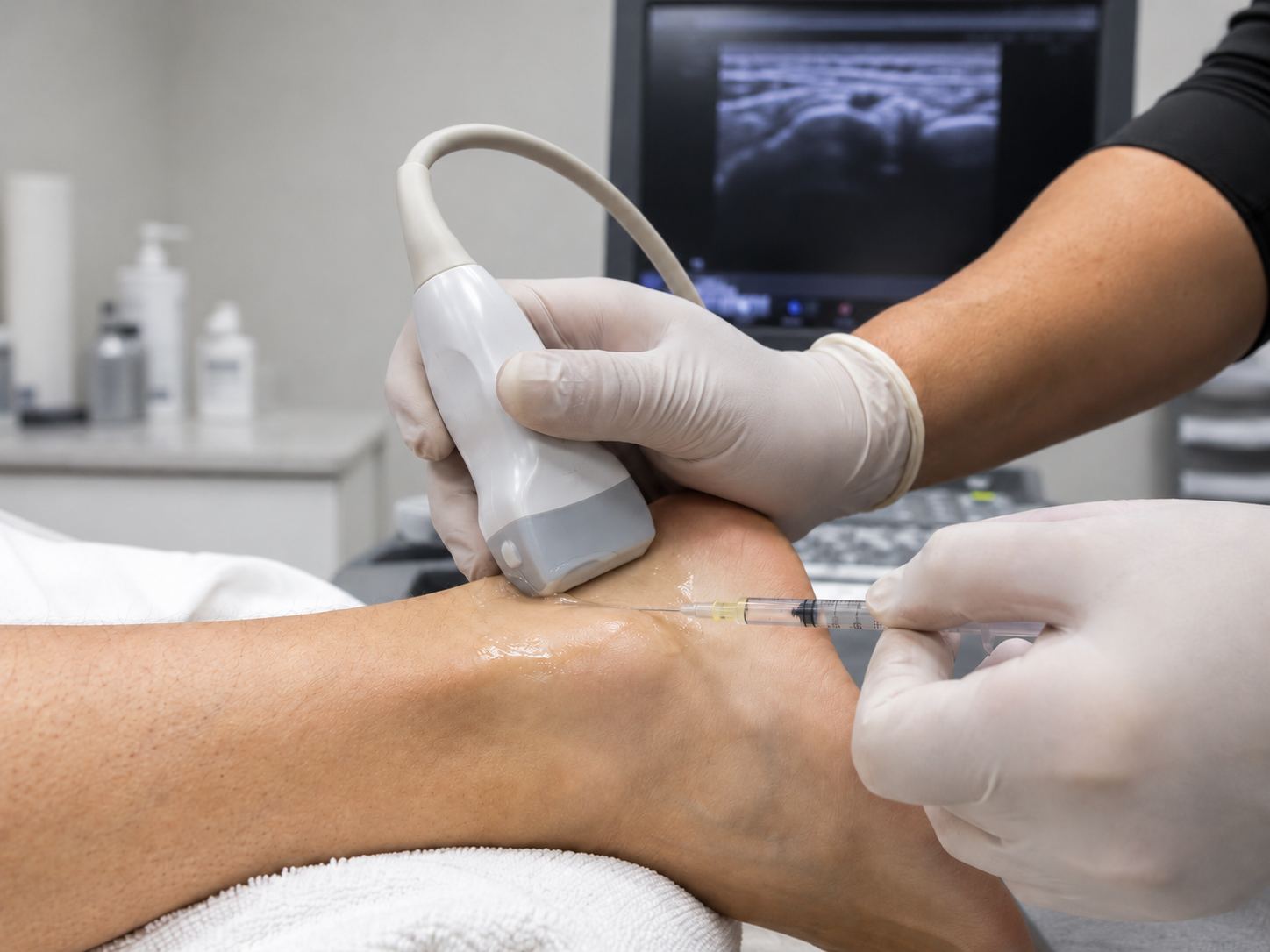
How is the treatment performed? Treatment is performed in the clinic using sterile technique. Ultrasound guidance will be used to visualize the injured tissue and guide placement of the product. The skin is cleaned, local anesthetic may be used, and the Interfyl product is prepared according to the manufacturer’s instructions. The procedure is usually brief, but the details vary depending on the body region, tissue treated, and whether the goal is to place the product into a soft tissue defect, around a tendon or fascia, or in another physician-directed location. Your physician will review the exact plan before treatment.
What is the recovery like? Recovery varies by diagnosis and treatment area. Temporary soreness, swelling, bruising, or a pain flare can occur after any injection or
tissue-based procedure. Patients commonly have soreness for the first 2–3 days after injection, although soreness may last up to 2 weeks in some cases. After that early soreness period, pain often begins to subside as the treated tissue becomes less painful. Some patients notice improvement within a few weeks, while others improve more gradually over 6–12 weeks or longer.
For tendon, ligament, and fascia problems, the injection is only one part of the plan. Bracing, activity modification, progressive loading, physical therapy, and correction of contributing biomechanical factors may be just as important as the injection itself. Your return-to-activity plan will be individualized based on the treated tissue and your sport or activity goals.
Is it safe? Interfyl is made from donated human placentas after healthy, full-term pregnancies. Donor screening and communicable disease testing are performed and the manufacturing process is designed to produce product absent of bacterial and fungal pathogens. Interfyl should not be used in clinically infected sites. It should not be used intravenously, intra-arterially, intra-ocularly, or intrathecally. It is contraindicated in patients with known hypersensitivity to Interfyl, and if a patient has had an adverse reaction related to prior Interfyl use, it should not be reapplied. General risks of any injection procedure include pain, bleeding, bruising, infection, allergic or immune reaction, injury to nearby nerves, blood vessels, tendons, or other soft tissues, and failure to provide relief. Ultrasound guidance may reduce risk by allowing the clinician to visualize anatomy during the procedure, but it does not eliminate risk. Notify your clinician before treatment if you have an active infection, fever, open wound
near the treatment site, history of reaction to human tissue products, immune suppression, cancer history, bleeding disorder, current anticoagulant use, pregnancy, or significant medical concerns.
After your session. You may be asked to limit strenuous activity for a period of time after treatment. The exact restrictions depend on the treated tissue. Avoid returning to heavy training, impact activity, or sport-specific loading until your physician or physical therapist clears you. Contact the office promptly for fever, worsening redness, drainage, increasing warmth around the injection site, severe or worsening pain, new numbness or weakness, calf swelling, shortness of breath, or any symptom that feels concerning.
What to consider when choosing Interfyl. Interfyl may be considered when the treatment goal is to supplement a soft tissue region with an extracellular matrix scaffold. Potential advantages include that it is off-the-shelf, does not require a blood draw, and can be prepared in a flowable form to conform to irregular spaces. Important limitations include that it is donor tissue rather than autologous tissue, clinical
evidence for musculoskeletal use remains limited, regulatory status is evolving, insurance coverage may vary, and no injection can guarantee pain relief or tissue healing. Patient factors such as diabetes, smoking, poor nutrition, inflammatory disease, medication use, and the severity or chronicity of the injury may affect outcomes.
Is it FDA approved? Interfyl is not FDA-approved as a drug or biologic treatment for orthopedic pain, plantar fascia pain, tendon injury, ligament injury, or joint conditions. Earlier package-insert language described Interfyl as a human cell, tissue, or cellular/ tissue-based product, or HCT/P, under Section 361 for replacement or supplementation of damaged or inadequate integumental tissue. As with all procedures, patients are encouraged to gather information, ask questions, and understand the potential benefits, risks, alternatives, costs, and uncertainties before pursuing treatment.
Selected References
1. Mao Y, John N, Protzman NM, et al. A decellularized flowable placental connective tissue matrix supports cellular functions of human tenocytes in vitro. Journal of
Experimental Orthopaedics. 2022;9:69. doi:10.1186/s40634-022-00509-4.
2. Protzman NM, Mao Y, Sivalenka R, et al. Flowable placental connective tissue matrices for tendon repair: A review. Journal of Biology and Medicine. 2022;6(1):10-20.
3. Vohra P, Vohra R, Beckett M, Japour C. Efficacy of Decellularized Human Placenta in the Treatment of Infracalcaneal Heel Pain. Desert Foot abstract/poster.
4. INTERFYL® Human Connective Tissue Matrix Package Insert. Celularity Inc.


Book an Appointment
We're Here to Help You
Ready to take the next step in restoring your physical health? Contact us today!


